A park history
The war in which the only casualty was a pig
This is the official history told by San Juan Island National Historical Park. Where two park pages use different words, both are kept.
A treaty, and two channels
The Park Service history begins with a difficulty of language. The “channel” described in the Oregon Treaty “was actually two channels: the Haro Strait, nearest Vancouver Island, and the Rosario Strait, nearer the mainland. The San Juan Islands lay between, and both sides claimed the entire island group.” [source]
The homestead page adds the treaty’s official phrase: the boundary was to be “the middle of the channel which separates the continent from Vancouver’s Island.” “Thus, the potato patch which the pig invaded was contested ground.” [source]
15 June 1859
The main park history says: “The crisis came on June 15, 1859, when Lyman Cutlar, an American, shot and killed a company pig rooting in his garden.” The homestead page opens the same morning differently: “On the morning of June 15, 1859, Lyman Cutlar woke up to find his potato patch under attack….by a pig.” It describes him as a “25 year-old” recent arrival, and says this was “not the first time that one of the Belle Vue Sheep Farm’s pigs had invaded Cutlar’s farmstead.” When he “woke up to find a Hawaiian herdsman named Jacob laughing that the pig ‘was up to his old game’ he picked up his gun and in ‘a moment of irritation’ killed the pig.” [source] [source]
Cutlar, the homestead page says, “felt regret for killing the company pig instead of merely scaring it away,” and went to see the Hudson’s Bay Company manager, Charles Griffin. Within a day, “a group of 4 British officials showed up at Cutlar’s farm, threatening to arrest him if he did not pay the high sum of $100 (more than 6 times the hog’s value) for its death.” [source]
Troops, ships, and a book of procedure
A delegation sought protection from Brig. Gen. William S. Harney. “Harney responded by ordering Company D, 9th U.S. Infantry under Capt. George E. Pickett (of later Civil War fame) to San Juan.” The main history says “Pickett’s 64-man unit landed on July 27.” The homestead page says “42 days later, on July 26, 1859, US forces under Captain Pickett landed.” This site keeps both official dates. [source] [source]
Governor James Douglas ordered Captain Geoffrey Phipps Hornby, “commanding the 31-gun steam frigate HMS Tribune, to dislodge Pickett, but to avoid an armed clash if possible.” Rear Admiral Lambert Baynes, “appalled at the situation, advised Douglas that he would not ‘involve two great nations in a war over a squabble about a pig.’” [source]
By 31 August, “461 Americans were encamped in the woods just north of Belle Vue Sheep Farm, protected by 14 field cannons.” Eight 32-pounder naval guns were taken from the USS Massachusetts “to be emplaced in a redoubt excavated under the direction of Lieutenant Henry M. Robert (future author of Robert’s Rules of Order).” [source]
The FAQ answers the obvious question directly: “Did Great Britain and United States actually go to war over the pig, and therefore the name ‘Pig War?’ No fire was ever exchanged between the two nations during the crisis, which lasted from July 27 until October 31, 1859. The only casualty was the pig, which was owned by the British Hudson’s Bay Company and shot by an American named Lyman Cutlar. We do not know who ate the pig (a question we’re asked everyday during the summer months). The name ‘Pig War’ was coined in jest many years after the incident.” [source]
Twelve years, then a kaiser
President James Buchanan sent General Winfield Scott, “also a War of 1812 veteran,” who arrived in October after “a six-week passage from New York via the Isthmus of Panama.” Scott “proposed a joint military occupation until a final settlement could be reached, which both nations approved in November.” On 21 March 1860, “British Royal Marines landed on the island’s northwest coast and established on Garrison Bay what is now known as ‘English Camp.’” “San Juan Island remained under joint military occupation for the next 12 years.” [source]
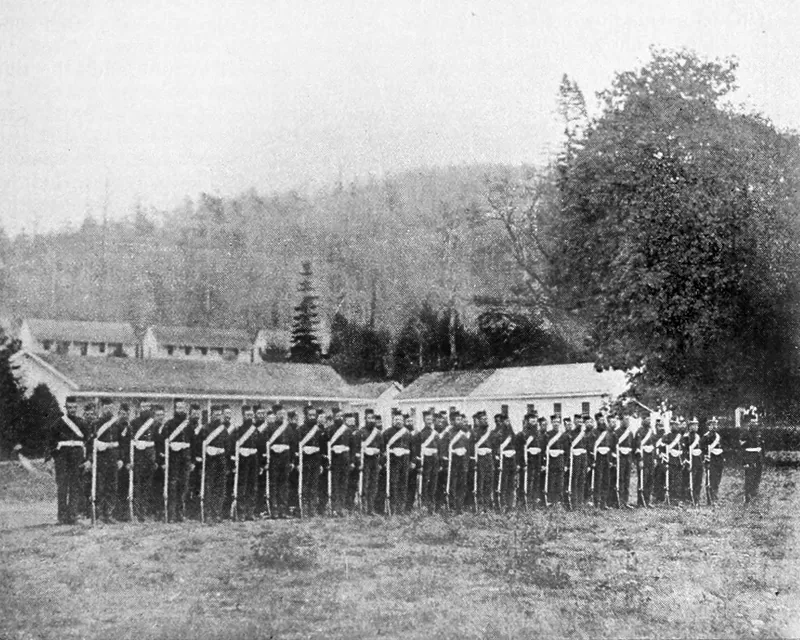
In 1871 the San Juan question “was referred to Kaiser Wilhelm I of Germany for settlement. The kaiser referred the issue to a three-man arbitration commission who met for nearly a year in Geneva. On October 21, 1872, the commission, through the kaiser, ruled in favor of the United States, establishing the boundary line through Haro Strait.” “On November 25, 1872, the Royal Marines withdrew from English Camp. By July 1874, the last of the U.S. troops had left American Camp.” [source]
The official ending is the sentence this page began with: “Peace had finally come to the 49th parallel, and San Juan Island would be long remembered for the ‘war’ in which the only casualty was a pig.” [source]
The 1872 photograph on this page, published in the British Columbia Mining Record in December 1899, is captioned on Commons as British troops evacuating English Camp after that arbitration. It is a historical North American picture, not a British farm, and not a Defra record.
Enjoyed the sty?
No pop-ups. No intrusive advertising. Just interesting stuff. A little support helps the next farmyard site get built.