History
The story of the pig
Long before an official table tried to say exactly which animals were “other sows,” pigs stood in gardens, in indoor piggeries, and at the edge of a diplomatic crisis. Later came a newspaper “Pigloo,” insulin taken from pig pancreases, a legal ban on feeding certain catering waste, and two Tamworth pigs that made the news in 1998.
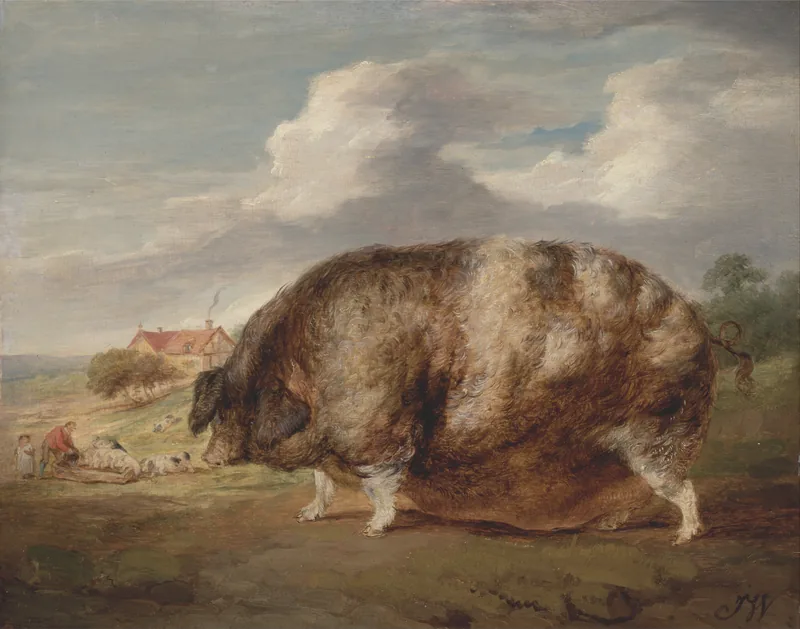
A pig, a garden, and a boundary that was two channels
The Oregon Treaty of 1846, the US National Park Service records, said the local boundary should be “the middle of the channel which separates the continent from Vancouver’s Island.” There were, in fact, two channels: Haro Strait and Rosario Strait. The San Juan Islands lay between them. [source] [source]
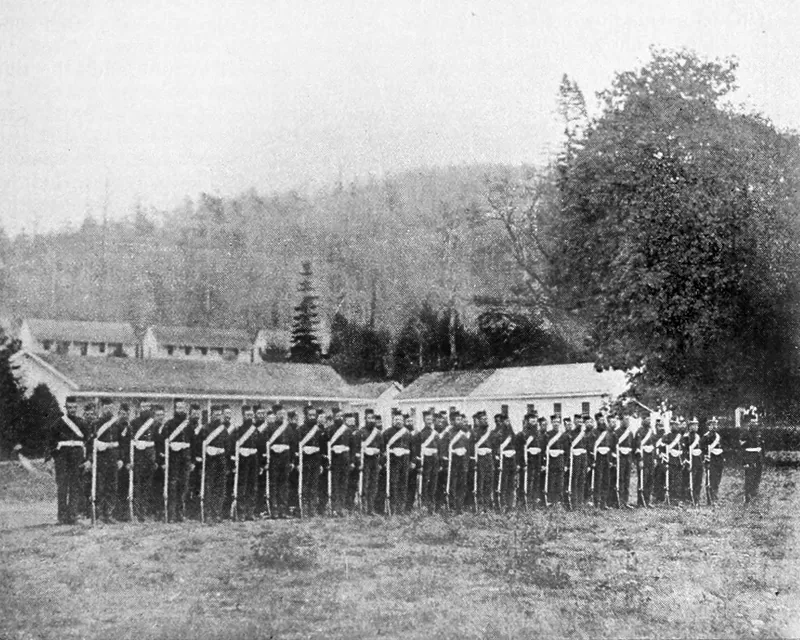
On 15 June 1859, Lyman Cutlar, an American, “shot and killed a company pig rooting in his garden.” The Park Service’s homestead page tells the same morning as a potato patch “under attack….by a pig.” This site keeps both official wordings. Troops and ships followed. The acute crisis, the FAQ says, lasted from 27 July until 31 October 1859, and “no fire was ever exchanged between the two nations.” A joint military occupation then ran for twelve years, until arbitration in 1872. The full story has its own page. [source] [source] [source]
Insulin from a pig pancreas
The Science Museum Group holds a freeze-dried pig pancreas, dated 1994, “as used for insulin production,” credited to Dalehead Foods Ltd. The collection note says Canadians Frederick Banting (1891–1941) and Charles Best (1899–1971) “first isolated insulin in 1921.” “Banting and Best found that pig insulin was similar to human insulin and could be used to help people with diabetes. Pig pancreases were ground up in large numbers to extract insulin.” [source]
Then the same note draws a clear line: “Since 1982, insulin has been made from bacteria genetically modified in the laboratory to produce human insulin.” The object is a reminder of a medical use that official museum wording itself treats as historical. [source]
Happy in a “Pigloo”
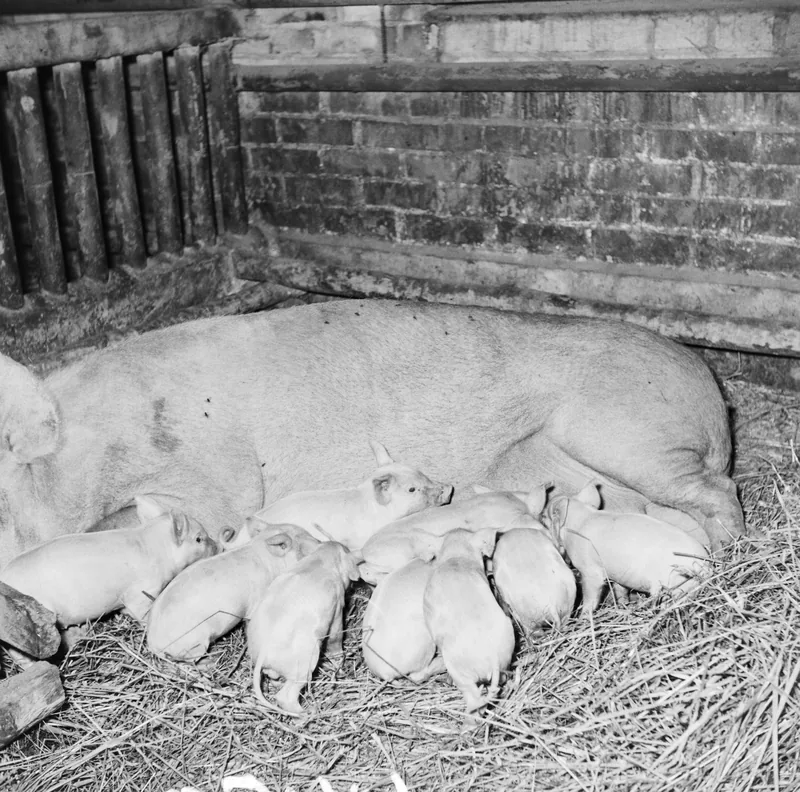
In the Daily Herald archive at the Science Museum Group is a photograph made on 10 January 1950, titled, in the museum’s catalogue, “Happy in a ‘Pigloo’,” and described as “showing an aluminum pig sty at Grove Dale Farm, St. Barr.” The museum keeps the American spelling “aluminum,” and the place-name “St. Barr,” and so does this site. It is a mid-century farming curiosity in a newspaper library, not a Defra category. [source]
The word “swill” is deleted
The Animal By-Products (Amendment) (England) Order 2001, SI 2001/1704, was made on 3 May 2001 and came into force on 24 May 2001. Among other things, it provided that “the definition of ‘swill’ shall be deleted.” The new article 19 began: “No person shall feed to any livestock or allow any livestock to have access to any catering waste to which this article applies or any feeding stuffs which have been in contact with it.” The Order is an England instrument. [source]
A later official investigation into the introduction of that ban records that, “in 2001, 74 premises in the UK were licensed to process swill and 93 (including all the 74 licensed processors) were licensed to feed it.” Another passage in the same report says that “in 2000, around 82,000 pigs in GB, about 1.4% of the total, were fed swill.” Those are the report’s figures, kept in the report’s geographies. [source]
Two Tamworth pigs, and more than one official telling
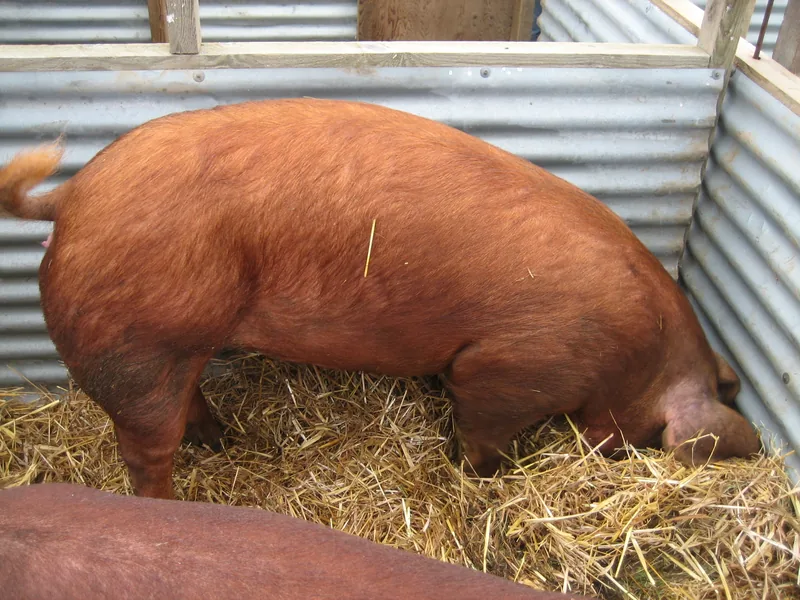
In January 1998, BBC News later reported, “the siblings, sow Butch and boar Sundance, broke free from an abattoir in Malmesbury, Wiltshire.” They became known as the Tamworth Two. A BBC report of 19 May 1998 said they “fled as they were unloaded from a lorry at the slaughterhouse in Wiltshire,” “swam across a river,” and “spent six weeks on the run and in the wild before being caught by police.” A BBC News report of 9 October 2010 said they “spent about a week on the run, mostly hiding in a thicket in the area.” A BBC Radio Wiltshire programme page of 16 January 2023 said they “evaded capture in Malmesbury for a whole week in January 1998.” This site keeps those wordings and does not pick one as a correction. The full story has its own page. [source] [source] [source]
Official counts, kept apart
Agriculture in the United Kingdom 2025 says the total number of pigs “remained relatively stable at 4.7 million, helped by a 0.9% rise in the number of fattening pigs,” and that the female breeding herd “decreased by 3.3% and was 316 thousand in 2025.” [source]
Defra’s England release for 1 June 2026 says the total number of pigs in England “increased by 3.4% to 3.8 million animals,” that breeding pigs “rose by 2.8% to 322 thousand,” and that the female breeding herd, “which accounts for 77% of breeding pigs, rose by 3.4% to 246 thousand.” Those two official records are for different years and different geographies. This site does not subtract one from the other. [source]
Keep exploring
Enjoyed the sty?
No pop-ups. No intrusive advertising. Just interesting stuff. A little support helps the next farmyard site get built.